

How blackjack payouts change your edge: understanding blackjack isplata 3:2 vs 6:5
I often tell players that one small-seeming rule can change your long-term results dramatically. When I talk about kako funkcioniše isplata u blackjacku, the first thing I check is whether a table pays 3:2 or 6:5 for a natural blackjack. Blackjack isplata 3:2 and blackjack isplata 6:5 look similar at first glance, but the 3:2 vs 6:5 razlika directly affects your expected return and the casino’s advantage.
In practical terms, the payout rule for a natural (an ace + 10-value card) determines how much you get when you hit a blackjack. Because play decisions and basic strategy assume the standard 3:2 payout, switching to 6:5 changes the math behind your plays and increases the prednost kuće 6:5. Below I break down what each payout means and give simple calculations so you can see the impact for yourself.
What 3:2 and 6:5 payouts actually pay and how to do računanje isplate blackjack
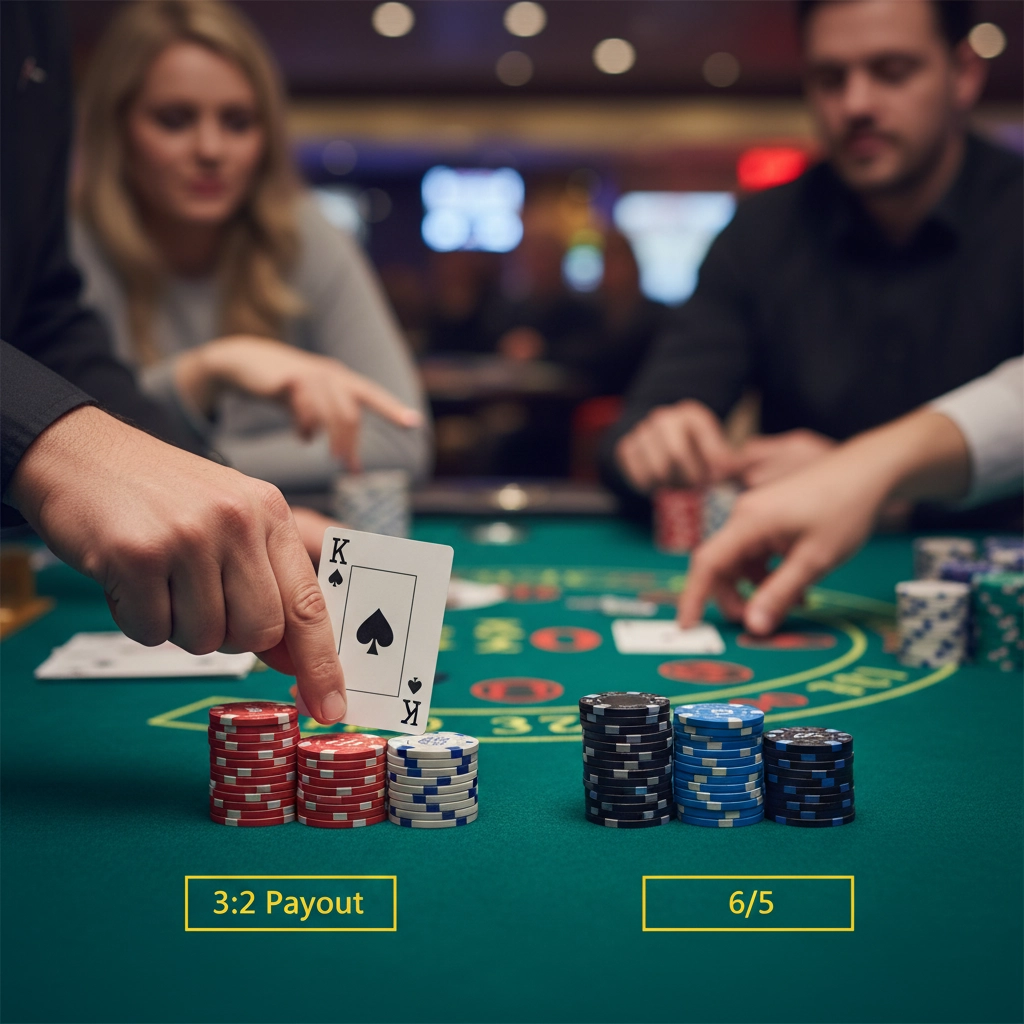
- 3:2 payout: For every $10 bet, a blackjack pays $15 (3/2 × bet). This is the traditional payout most basic strategy charts assume. When I calculate expected value, 3:2 keeps the house edge much lower.
- 6:5 payout: For every $10 bet, a blackjack pays $12 (6/5 × bet). That’s $3 less per $10 on a winning blackjack compared to 3:2.
To illustrate računanje isplate blackjack with a quick example: if you bet $10 and get a natural, 3:2 returns $15 profit; 6:5 returns $12 profit. Over hundreds or thousands of hands, that $3 difference per blackjack adds up significantly and is the core reason zašto je 6:5 lošije od 3:2.
From an RTP perspective—I pay attention to RTP blackjack 3:2 6:5 when advising players—standard single-deck or multi-deck blackjack with favorable rules and 3:2 blackjack pays can produce high RTPs (often above 99% with perfect basic strategy). When casinos offer 6:5 instead of 3:2, the RTP drops and the prednost kuće 6:5 rises, often turning a close-to-even game into one where the casino enjoys a noticeably larger margin. Exact numbers vary with other rules, but the direction is always the same: 6:5 worsens your expected return.
I also note that pravila isplate u blackjacku are only one part of the table rules—dealer stands/hits on soft 17, doubling options, and surrender rules also matter—but payout is one of the easiest adjustments to spot and to quantify for your bankroll.
Next, I’ll walk through concrete hand-by-hand examples and show how to recalculate expected return and adjust your isplata blackjack strategija when faced with 6:5 tables so you can decide whether to play or walk away.
Hand-by-hand examples: seeing the 3:2 vs 6:5 difference in real numbers
Let’s make this concrete with a few simple hands and a quick expectation calculation so you can see how the math plays out at the table.
Example 1 — single-hand payout
– Bet: $10. You’re dealt a natural (Ace + 10-value).
– 3:2 payout: you win $15 profit (your original $10 + $15 = $25 returned).
– 6:5 payout: you win $12 profit (your original $10 + $12 = $22 returned).
Difference on that one hand: $3 less with 6:5.
Example 2 — expected cost per hand (using an approximate blackjack frequency)
You don’t hit a natural every hand. A typical multi-deck game produces a natural roughly 4.8% of the time (about 0.048 per hand). The expected loss per hand from switching payout is:
Expected loss = P(blackjack) × payout difference
= 0.048 × $3 ≈ $0.144 per $10 bet, or 1.44% of your bet.
Scale that up:
– Over 100 hands at $10: ≈ $14.40 extra loss.
– Over 1,000 hands at $10: ≈ $144 extra loss.
Those numbers match what many players notice: a table advertising 6:5 is effectively increasing the casino’s edge by roughly 1.3–1.6 percentage points compared to a similar 3:2 game. That’s not a rounding error — it’s the reason I check the payout before I sit down.
How to recalculate your expected return and adjust strategy when you see 6:5
If you want a quick rule of thumb to convert a familiar 3:2 house edge to its 6:5 equivalent, use this approach:
1. Start with the house edge you expect for the ruleset with 3:2. (For many “good” games that might be ~0.5% with perfect basic strategy; for looser rules it might be higher.)
2. Add the expected loss caused by the payout change: roughly P(blackjack) × 0.30×bet. Using P(blackjack) ≈ 0.048, that’s ≈ 1.44% of bet.
3. New house edge ≈ base_edge_3:2 + 1.44%.
Example:
– Base house edge (3:2 game) = 0.5%
– Add payout penalty ≈ 1.44%
– New house edge (6:5) ≈ 1.94%
What that means in practice
– Your breakeven requirements, bankroll sizing, and expected hourly loss all change accordingly. If you normally planned for a 0.5% house edge, a 6:5 table almost quadruples the expected loss.
– Basic strategy: in most cases the standard basic strategy chart still gives you near-optimal decisions because the change is a straight reduction of blackjack payoff, not a change to hit/stand/double odds. However, in very close EV spots the small shift can flip the correct play. If you want precision, run a solver or use a strategy chart custom-made for the exact rule set (decks, dealer S/H on soft 17, doubles, etc.).
– Practical response: when possible, avoid 6:5 tables entirely. If your choices are limited and you accept the entertainment value, reduce bet size, favor tables with other player-friendly rules (S17, double after split, surrender), and don’t rely on insurance — it becomes even less attractive under 6:5.
I always tell players: spotting a 6:5 sign should trigger a quick calculation — if the rest of the rules are poor too, walk away. If the table is 6:5 but otherwise excellent, treat it as a more expensive seat and adjust your bankroll and expectations accordingly.
Practical next steps before you sit
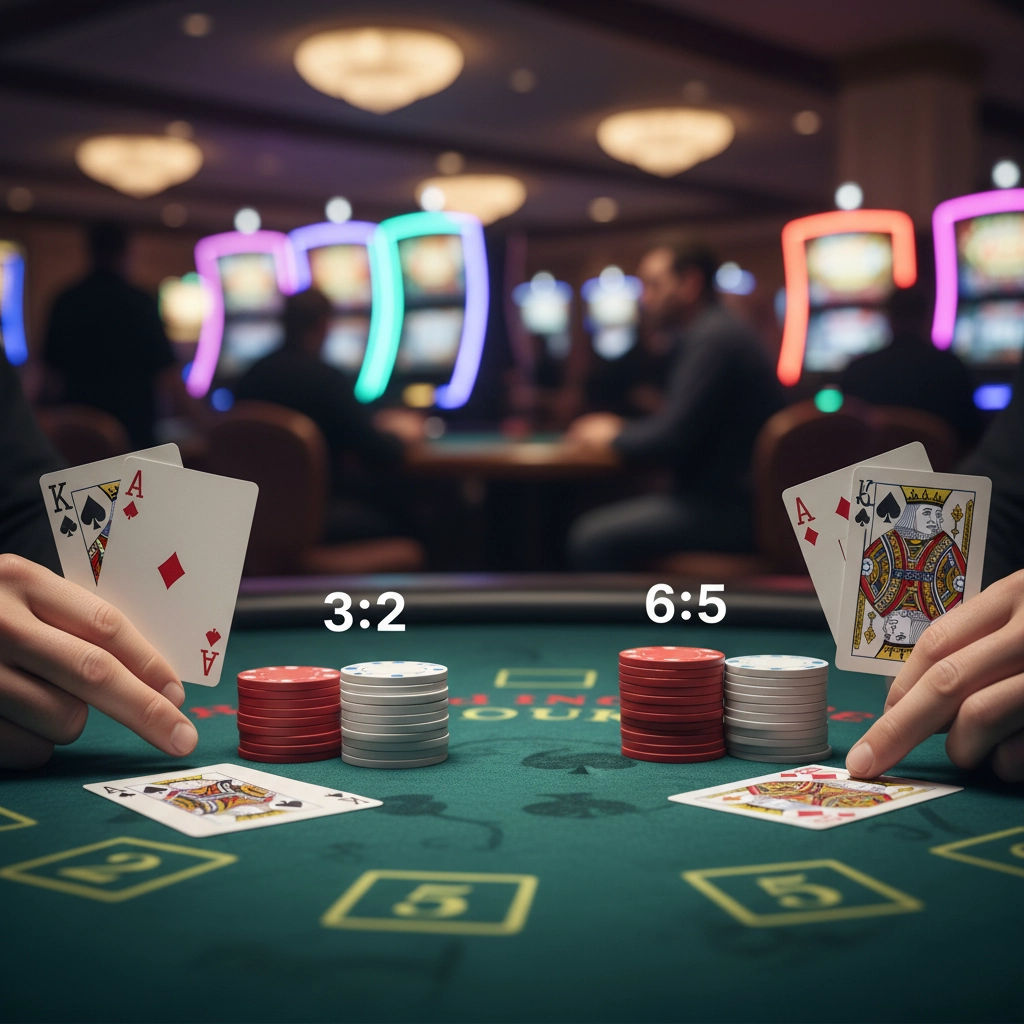
When you see a 6:5 sign, take a few seconds to decide whether the seat is worth it. If you choose to play, use simple, low-friction adjustments to protect your bankroll:
- Check the other rules at the table (dealer S17 vs H17, DAS, surrender) — good rules can partially offset the payout penalty.
- Reduce your bet size to match the higher effective house edge and stretch your session.
- Skip insurance; it becomes even more unfavorable with 6:5 payouts.
- If you want exact numbers, run a quick calculator or consult a solver for the specific deck count and rules.
Choosing a seat: final advice
If your goal is to minimize expected loss, avoid 6:5 tables. If you’re playing for entertainment and expect to pay a premium for a particular table or casino, treat 6:5 as a known cost and plan accordingly — smaller bets, stricter session limits, and choosing the best remaining rules. For deeper reading on how payouts and rule variations affect blackjack expectations, see Wizard of Odds: Blackjack Payouts.
Frequently Asked Questions
How much worse is a 6:5 payout compared to 3:2?
For most multi-deck games, switching from 3:2 to 6:5 increases the casino’s edge by roughly 1.3–1.6 percentage points. In dollar terms, on a $10 bet you lose about $0.144 per hand on average from the payout change alone (using P(blackjack) ≈ 4.8%).
Should I ever play at a 6:5 table?
Only if there are compelling non-mathematical reasons (convenience, companions, promotions) or if other rules at the table are exceptionally favorable. Otherwise, prefer 3:2 tables — or lower your bets and keep stricter session limits when playing 6:5.
Does 6:5 require changing basic strategy?
Generally, standard basic strategy remains close to optimal because the relative probabilities of hands don’t change. However, in borderline EV spots the reduced blackjack payout can flip the correct play. For precise adjustments, use a solver or a strategy chart tailored to the exact rules and deck count.